Background
Previous article: https://paulecoyote.wordpress.com/2009/02/22/agile-development-vocabulary
This estimation technique based on a simple game of rock, paper, scissors (RPS) is something we have already experimented with to estimate story points for a task. A story point is a measure of complexity and size of a task (see Agile – Vocabulary), though could be used to estimated time too.
Rock Paper Scissor Estimation… For the win?
Planning Poker
First of all planning poker seems to be way more documented than rock paper scissors estimation, and there are tons of resources about it already on the web. If planning poker is not familiar to you I would definitely recommend reading up a little about it. Feel free to also comment if you have come across another discussion on rock paper scissors used in this way for estimation.
In planning poker each player involved in estimation is given cards with a Fibonacci number on representing how many story points a task is worth. Sometimes decks use a base 2 binary numeral system – something probably more familiar to many software developers. These are played face down, and on reveal the highest and lowest guessers talk about their estimation with the other players. Play continues until the values converge. The strength of rock paper scissors is no props are necessary!
Roshambo!
The rock paper scissors method has roots in the Delphi and Wideband Delphi methods of estimation – but less formal.
Setup
Make sure the people you are playing with have the same idea about what a unit story point is. It is best if it is a completed simple task you are all familiar with, otherwise you have to start with an agreed duration of time on a task (e.g. half a day).
Nominate one person to marshal the session. This might be the scrum master (if you are practicing scrum) but the role should switch between team mates. Rotating the role allows members of the team to grow in confidence talking with their co-workers, encourages joint ownership of the estimation process and it helps the team to jell.
A list of tasks should be given to the marshal to familiarise him or herself with. The marshal then arranges the meeting.
Scale
Personally I prefer play with the binary numeral system because it is really easy to remember. You may prefer the Fibonacci numbers which is fine. Adjust the scale for larger problems or use both hands. Large amounts of story points indicates that the task estimated should be broken down in to more manageable chunks.
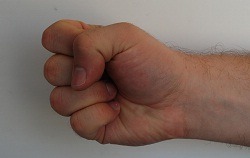
- 0 Fingers:
 Less than 1 story point
- 1 Finger:
 1 story point
- 2 Fingers:
 2 story points
- 3 Fingers:
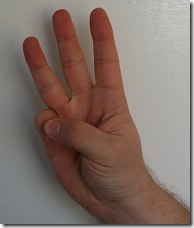 4 story points
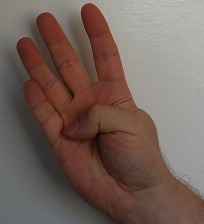
- 4 Fingers:
 8 story points
- 5 Fingers:
 12 story points
Play
- The marshal introduces a task to the group. Brief further definition of task might be necessary but the marshal should not allow too much detail to be discussed at this point. It may sway initial estimates, especially if the perceived senior authority on the subject starts talking about complexity and size too deeply.
- Marshal counts to three. At the count of three everyone presents their hands at the same time to the rest of the group.
- The person with the largest estimate explains to the group what made them guess the highest. This helps to draw out unknown facets of the task.
- The person with the lowest estimate explains to the group what made them guess the lowest. This helps to draw out false assumptions, or perhaps something helpful that could simplify working out the task.
- Marshal calls for another round of estimations (back to step 2). Process repeats until the estimates converge. Estimates should converge, once they do return to step 1 and repeat for each task.
Scale of tasks can be an issue with this form of estimation using the binary numeral system “is Task X really twice as hard as Task Y?”. Greater scale accuracy can be achieved by using different combinations of fingers. If using the binary method that could be holding up different combinations of fingers (thumb and index finger could mean “3” for example). That has it’s own problems because some combinations of fingers are actually pretty hard to carry off for people with less flexible hands.
The strength of this method is that it does not necessarily even need a formal meeting or marshal. A group of a few people can easily estimate using this method in a corridor, at a desk, etc.
Links








 Paul Evans